A PT’s Path to Disaster Response
Megan Mitchell, PT, DPT, MPH
Have you ever watched a disaster unfold in your community and felt the need to step in, to be included, because you knew that your professional skills could make a difference? This was part of how I started my journey to change my professional practice to work in the emergency care and disaster response space.
I began my career working at a level one county hospital covering practice areas in general medicine, orthopedics and general surgery services. Eventually, I transitioned to the primary PT in the trauma ICU for adults and pediatrics. This was the kind of place where catastrophic injury destroyed lives and families, but my resilience and skills grew. I spent 14 years at this hospital and since the beginning, I covered PT consults within the Emergency Department: adult, pediatric, L&D, and psychiatric EDs. My experiences working in the ED had a profound impact on my career trajectory and desire to function in this space full time.
Around 2017, the Emergency Department started discussing the building out of a dedicated PT pathway. Controlled chaos, constant pivoting and the need for meaningful in-the-moment decisions that had immediate impact felt very rewarding. I was fully in support of this program development. It had been recommended that I take a continuing education course to refresh and update my skills for acute injury recognition and management. At the time, the most relevant course was offered through the Sports Section of the APTA. I flew from Denver to Portland, Maine to take this course and it happened to fall on the same weekend that Hurricane Harvey made landfall in Texas. As I watched the news reports and saw the images of elderly residents sitting in wheelchairs and awaiting rescue, I was struck by the realization that everything I was learning in this course was applicable to disaster response. I wanted to do that. I wanted to be a part of the response operations and provide immediate care to those who needed help but didn’t need hospitalization. One of the main functions within the ED is to manage non-critical acute injuries and avoid unnecessary hospital admissions. On my quest to find out how to do this, it was disturbingly light on information and a harsh realization that within the United States, physical therapists are not included in this capacity. I had to find evidence and education from our international colleagues.
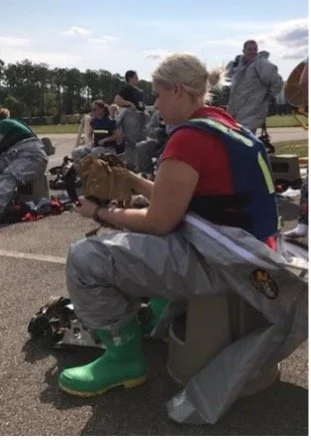
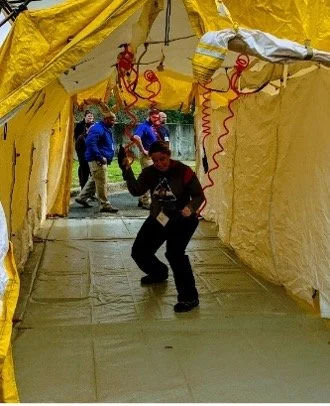
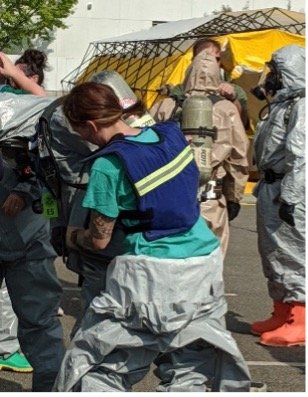
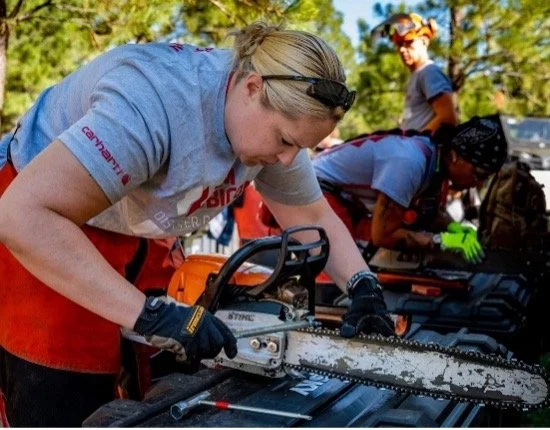
Within my day-to-day role in the ER, I had made it clear to my leadership and to the ER leadership that I was interested in getting more involved in hospital disaster planning. The hospital was working on their facility-wide disaster training with an Emergency Manager who was eager to build an internal Emergency Response Team. I raised my hand. It was then that I was asked to be part of the team lead for facility teaching and training for CBRNE (chemical, biologic, radiologic, nuclear, and explosive) awareness and response operations and for mass casualty response. Federal training was offered at the Center for Domestic Preparedness in Anniston, Alabama. It was my second training at CDP where I was further certified as a Hospital Emergency Response Trainer. I completed this second training just after Covid-19 was detected within the United States but before quarantine orders were issued. Many of the discussions within the class were around how to quarantine and protect hospital staff from this contagion. I knew where PT could plug in and play a critical role in hospital response.
Over the duration of the pandemic I became increasingly frustrated with the lack of awareness or receptivity of the medical community to the role and added value of PT. In some locations PT was deemed essential but in others, a luxury item. The medical community focused on limited assets of MD, RN, paramedic and RT. However, PT was still operating in the thick of everything as a critical resource with as much, if not more, risk for exposure as we were not able to mobilize vented patients at arm’s length. I had an opportunity to sit in on a Governor’s board meeting addressing Crisis Standards of Care and one component used to assess resource allocations was the expectations for rehabilitation and recovery. Unfortunately, none of the board members had any background or training in rehabilitation. It was then that I decided to rip off the band-aid and return to school.
My return to school for my Master’s in Public Health had a focus on global disaster management, homeland security, and humanitarian aid. The intent of this degree was to increase the role of physical therapy across the disaster continuum. My interests specifically were to engage PT in the operational response both domestically and internationally. As a part of that curriculum, I was required to complete a fieldwork assignment and applied for a role in disaster advocacy and outreach education. However, my resume reflected greater clinical experience with teaching. The need for rehabilitation professionals skilled in emergency and trauma care with teaching experience was a greater need for this organization than functioning as an advocacy intern. I did not think that I would get the chance to function in this capacity given my deficient language skills, so, I jumped at the chance and that is how I ended up working in Eastern Ukraine. I finished my MPH after I returned from Ukraine.
I loved my experiences working in multiple capacities during disaster response; between operations with Team Rubicon, Denver EOC, Humanity and Inclusion and at CDP. I knew I wanted this to be a role that I could bring to the domestic scene. The need for physical therapy within the domestic scene is already prevalent and is only further compounded when disasters occur. Traditionally, rehabilitation services are pushed to later stages in a disaster, after the initial response and stabilization. My belief is that this is due to a fundamental lack of understanding of the skills and scope of PT by the larger healthcare system, lack of understanding for where PT can plug in during initial response by PT providers, lack of defined roles within procedure development and lack of shared language with emergency management. Historically, rehabilitation has been a term used in emergency management during the later stage indicating the rebuilding and restoration of the community. Unfortunately, rehabilitation services need to be more proactive in breaking out of our silo to re-educate our colleagues on the need and benefit of early PT engagement.
I am here to give you a glimpse into the role PT in disaster response. As of today, I am the only practicing PT within the Administration for Strategic Preparedness and Response working with our National Disaster Medical System. I am rostered for international disaster Emergency Medical Teams verified by the WHO with 2 different agencies and I still work clinically in a hospital system. Change is happening and I plan to be a part of it. My path is not the only path, but I will try to discuss access options.
For those wishing to engage in domestic disaster medicine, you’ll need to start by learning the fundamentals and sharing the same language as those making the decisions. Whether you are starting with a CERT (Community Emergency Response Team) or you want to volunteer or work with a facility response team, start with Incident Command Structure and National Incident Management System training.
Step 1:
Sign up for a student ID with FEMA (SID): https://cdp.dhs.gov/FEMASID/register
Step 2:
Complete online training for ICS 100, 200, 700 and 800
https://training.fema.gov/nims/
Don’t worry, they’re all free and can be completed on your own time. Full disclosure, the content is dry but necessary.
Step 3:
Connect with an Emergency Manager or Director of Safety to engage with training opportunities. From there you’ll have a better understanding of what you like, don’t like, or where to improve.
Updated APTA Policy Guidance is available on the APTA website.
Burger, J., Gosney, J., Mitchell, M. (2025). The Role of Therapists in Emergency and Disaster Management. American Physical Therapy Assoc.https://www.apta.org/contentassets/fda282ffca6e46bfbc4c7f1919c58254/role-of-the-pt-and-pta-in-disaster-management.pdf